Tuesday, May 05, 2026

quiet

In a recent paper (Gatt 2025), Kurstin Gatt examines the perception of Malta in the imagination of its Arab neighbors and, by extension, their language. Specifically, Kurstin looks at Arabic idioms, proverbs, and sayings featuring Malta, and classifies them according to the semantic role Malta plays. These sayings range from classics like the Tunisian mālṭa l-ḥnīna ḫubza w-sardīna "Malta the kind, bread and sardines" (meanwhile also adopted in Maltese as an expression of love of the country or a nostalgia for a past version of it or as satirization of both previous sentiments) to various forms of "VERB after the destruction of Malta" meaning "a day late and a dollar short" (or what we in Slovakia express as "coming with a cross after a funeral"). As Kurstin reports, the latter can even be found in contemporary Egyptian popular music as gāy baʿd mā ḫirbit mālṭa "you came after Malta was destroyed". Go read the whole thing, it is fascinating; in fact go read the whole book, it is free.

The meaning Kurstin discusses for the bread+sardine proverb/saying references Maltese migration to North Africa, specifically Algeria and Tunisia. By mid-19th century, there were some 6000-7000 Maltese in Tunisia who formed the majority of European population in cities such as Sfax and Sousse. Their presence was also quite prominent, so much so that there was a street in Tunis called "Rue des Maltais". Incidentally, one of the businesses located on that street was the publishing house of Uzan Père & Fils, the publisher of many fine books in Judeo-Arabic.


"Rue des Maltais" is also the subject of a book with the same name written by Marc Donato, author of multiple books on Maltese emigrants in North Africa. I got the book yesterday and in a moment of serendipity, I cracked it open on page 28 which happens to discuss the place of Malta in the imagination of their Tunisian neighbors. Specifically, it mentions a man at the end of the 19th century trying to calm his child by saying to them:

Lukân mä toskòtš tòwwa nebbàetek fi mâlta

If you don't stop crying (lit. "don't become quiet") right now, I will send you to Malta!

This warning serves - at least according to Donato - as a reminder of the era when Muslim inhabitans of North Africa (especially the Barbary Coast) were often abducted to slavery in Malta, possibly in the galleys. Whether this is the real origin of the saying or it is another example of Malta serving as an exemplum for a far-away place (Gatt 2025: 324), it is definitely a worthy addition to Kurstin's collection.


Sunday, April 26, 2026

cowgirl

My (at this point future) wife is currently writing her dissertation that involves late antique rhetoric and theology and their view of women. To avoid going crazy dealing with medieval Latin, she regularly switches to reading more theoretical or similarly themed works. I am not sure it works as a distraction, because theoretical works give her migraines (which, you know, makes sense) and similarly themed works often just end up pissing her off. She then shares her annoyance with me (and now with everyone as well) and then I get pissed off too, because goddammit, some people...

A case in point, yesterday's distraction: Bettany Hughes' Helen of Troy: Goddess, Princess, Whore. In chapter 20 on p. 144 (the 2005 Jonathan Cape edition), in her discussion of the salacious description of Helen's - alleged - sexual practices in Joseph of Exeter's De bello Troiano (3.330-338), Hughes makes the following statement:

"When Joseph was writing in the 12th century, it was considered a sin for women to be on top during intercourse. Anything other than the ‘missionary position’ was unnatural because it made the woman physically superior; it was the mark of a whore and was thought to pervert the course of semen."

This gave both of us a pause. Neither of us is a medievalist proper, but both of us know enough of medieval theology, canon law and church history to be extremely suspicious of such sweeping statements. So naturally, we both strained our eyes to check the citation, only to find that there is none. The next paragraph cites a different text, Alain de Lille's Liber de planctu Naturae ([0431D]), in which Helen is blamed for Paris' homosexuality. Hughes then goes on to discuss penances for 'unnatural' sexual positions, but again, only in generic terms and no citations are given for this particular sin. Adultery is mentioned with reference to Canones Theodori and Payer's book on sex in the penitentials, but nothing on sexual positions. At the end of the paragraph, Hughes repeats her claim, with even more detail (p. 145, emphasis mine):

"In the 11th century, St Peter Damian preaches a required period of twenty-five years fasting and penance for married couples over the age of twenty who have indulged in ‘deviant’ sexual positions. These ‘bestial acts’ and ‘whorish embraces’ were thought to lead to all kinds of human misery; one late medieval theologian went so far as to say that God had sent the biblical Flood because he’d espied a couple having sex with the woman on top.10"

This time, there is a citation, hidden behind endnote no. 10: 

Brundage (1993), 87

i.e. 

Brundage, J. A. (1993) ‘“Let Me Count the Ways”: Canonists and theologians contemplate coital positions’, in J.A. Brundage (ed.), Sex, Law and Marriage in the Middle Ages. Aldershot, Hants: Variorum.

This volume being a collection of Brundage's papers, the citation comes from Brundage's seminal (so the clanker Google keeps pushing tells me) paper of the same title published in 1984 in Journal of Medieval History. The page numbering remains the same, so let us now turn/scroll to p. 87 in Brundage 1984 and...

Well, here's the thing: p.  87 in Brundage 1984 discusses specifically changes to theology of coital positions. It contains 3 specific claims:

  1. "The evidence seems to show that late medieval society had reached no general consensus concerning the seriousness of deviations from conventional marital sexual behavior. There seems to have been a popular belief, on the one hand, that whatever their personal peculiarities, the sexual relations of married couples were by definition without sin..."

  2. "A few late medieval theologians adopted a moderate view of sexual transgressions within marriage. Marcus von Weida, for example, maintained that sexual sins in marriage were common but not serious enough to require confession and formal penance. Those guilty of such sins, Marcus taught, could earn forgiveness simply by blessing themselves with holy water, saying a pater noster, or giving alms."

  3. "Others saw the matter quite differently; and a few of the major moral writers of the Reformation period considered non-standard coital positions a heinous kind of “unnatural” sex. After all, one of them remarked, it was the practice of having sexual intercourse with the woman on top that caused God to send the Biblical flood (Romans 1.26-7) - a drastic cure for this perversion (Lindner 1929: 162)."

If you pay close attention, you will notice that Brundage's claim 1 indirectly contradicts Hughes' claims about some sort of consensus in medieval Christianity - or at least in the 12th century - regarding sexual positions. Brundage's claim 2 undermines it further: if there is indeed such a thing as a sin relating to sexual positions within legally and theologically sanctioned marriage (at least in the 15th-16th century, at Marcus von Weida's time), it is far from "the mark of a whore ... pervert[ing] the course of semen", as Hughes' insists.

And finally - and more importantly - there is no trace of the "one late medieval theologian" whose opinion she relies on. Brundage's claim 3 contains the story of the flood sent by God as punishment for the sin of cowgirl recounted by Hughes, so maybe Brundage's source is where we can find this theologian. Lindner 1929 refers to Dr. Dominikus Lindner's Der usus matrimonii: Eine Untersuchung über seine sittliche Bewertung in der katholische (sic Brundage) Moraltheologie alter und neuer Zeit, so off to p. 162 we go and... nothing. This page concludes book's section 3 on high and late Middle Ages and contains the same description of Marcus von Weida's teachings summarized in Brundage's claim 2. No flood, no cowgirl, nothing.

So to sum up: Hughes makes a claim about a medieval Christian practice and supports it by a reference to "one late medieval theologian" which is in turn supported by a citation to Brundage. The place in Brundage contains the same story Hughes narrates which is supported by a citation of Lindner which, however, does not contain anything even remotely relevant.

I wish I could say this is a uncommon occurrence. It is not. I can't count the times I followed a footnote or endnote in an academic work - or hell, even a popular work - only to find out that this source says nothing even remotely close to what the author claims it does or that it even contradicts it directly. But bulbul, you may retort, people make mistakes, surely we should be more forgiving and less nitpicky. To which I reply, who are you and how did you get in my house, and also, not these kind of mistakes and maybe people who make these kinds of mistakes should not have publishing contracts and endowed chairs.

But what makes it even worse is what this says about the work before us, i.e. Bettany Hughes' Helen of Troy: Goddess, Princess, Whore. Chapter 20 where this can be found is one of 44 and the only one that directly addresses Helen's alleged sexual transgressions - the chapter title is literally "Helen the Whore". In this chapter Hughes argues that 

"...after the 2nd century AD, in an increasingly Christianised world, the notion of ‘Helen the wanton’ takes firm hold. She becomes typecast not simply as a wilful woman but as a tart."

Her main evidence is Joseph of Exeter's poem and Dante and then... nothing, at least for the Middle Ages; the remaining sources are early modern, late 16th century. And even the argument is weak: Joseph's text hinges on the interpretation of the word 'incumbens' which, according to Hughes (in footnote 6 on p. 143):

"supports either the notion of Helen being ‘on top’ or of her pressing into Paris’ body." 

Hughes obviously chooses the former interpretation and then proceeds to make the claim about how cowgirl was this horrible sin in the Middle Ages which she then completely fails to support, as shown above. In the course of the attempt, she

  • cites irrelevant material (adultery is not the same as the horrible sin of cowgirl) 
  • gives one source (11th century Peter Damian) without any citation 
  • fails to check her sources
  • possibly confuses what her sources say (I think that the "one late medieval theologian" she refers to is Marcus von Weida based on her misreading of Brundage 1984: 87)
  • thinks it is completely fine to use an unnamed "late medieval theologian" as a source
  • and thinks she can cover one entire aspect of the reception of a literary figure in one entire period of human history in 5 pages

It's the last part that is infuriating. But then again, it makes sense: I would expect nothing less from a classicist than to dismiss all of Middle Ages as a single unified period where all the people thought the same, believed the same, and were just a bunch of ignorant superstitious yokels anyway.

Wait, what is that? "[Hughes] graduated with a degree in ancient and modern history." 

So careless and lazy, then. 

Wednesday, April 15, 2026

mesolect

In the introduction to his Urban Jamaican Creole: Variation in the Mesolect (Benjamins 1999), Peter L. Patrick writes (emphasis and annotation mine):

Accordingly, creolists have often focused on ‘folk speakers’: people living traditional lives in rural areas, especially the elderly, who are usually the best source for archaic speech (Kurath 1949: 7ff). Their conservative varieties, called basilectal, are idealized and opposed conceptually to the most standard local speech, characteristically used by people at the top of the social scale, which is known as the acrolect. Varieties intermediate between the two are referred to as the mesolect; and the scale along which all these are ranged, as the creole continuum. Many creolists have until recently been primarily concerned with describing and analyzing the basilect, which is typically idealized as “the creole” in opposition to everything else — for example, Jamaican Creole as opposed to Jamaican English (the acrolect conceived as a dialect of international English). (Patrick 1999:5) 

I was somewhat stunned to read these words, not because I learned anything new, quite the opposite: these 11 lines (in the physical book) perfectly summarize a problem I have been trying to wrap my head around for the last two or three years. Except where Patrick speaks to and about creolists, my problem involves Arabic varieties and Arabic dialectologists. Disregarding the issue of the creole continuum, Patrick's diagnosis fully applies to a large portion of research in Arabic dialectology:

  • focus on elderly rural speakers
  • focus on archaic varieties/features
  • the idealization of said archaic varieties as "the dialect"

Don't believe me? Then consider the following passage from a recent description of an Arabic variety of ... Well, I don't want to put the authors on the spot and also I am writing a commissioned review of the book, so names shall be changed to protect the not-entirely-innocent. Let's call the rural town Ayn Wadi and the country Watan, the book would then be titled The Dialect of Ayn Wadi (Watan) (emphasis mine):

The major data collected during the field research are free speech audio recordings of improvised narratives about customs and activities in the town. Many informants I tried to work with were unable to narrate facts and stories in front of a recorder without mixing the local dialect with standard Watani. With these informants, I could only check lexemes without recording them to verify the recorded data with a broader spectrum of speakers. All the speakers were over 50 and many recalled the dialect spoken by their parents. The younger generation represented by youths and children were only briefly interviewed and they seemed to preserve only a few of the archaic features..."

It's all there: elderly speakers, archaic features, and the idealization of varieties spoken by elders as THE dialect of Ain Wadi. Only data from speakers over 50 is taken into account and on top of that, all the texts in the book were produced by people in their late 70s and early 80s. And then they are exactly what you would expect if you have ever read any description of an Arabic variety: memories of the old world, religious traditions and holidays, and traditional crafts.

Now there is nothing wrong with collecting spoken data from elders, far from it; there should be thousands upon thousands of field researchers armed with RØDE Wireless GO III doing exactly that all over the world. The problem here is that if you discount all the speakers younger than 50 - many of whom, nota bene, report not on their language, but on the language of their parents - is the variety you describe really the dialect of Ayn Wadi? No, of course not. Such research is not only misleading at best and disingenous at worst, but also - and this is far more important - constitutes a missed opportunity. Variation within the dialect could have been studied in multiple dimensions,  the contact between the local dialect and standard Watani or even between the local dialect and the other varieties spoken in the immediate area could have been examined, and of course we could have so much data on the speech of young people in a complex linguistic landscape, not to mention data on standard Watani (if there even is such a thing). But alas, speakers were apparently turned away (or, worse, their data was discarded) because they did not "preserve... the archaic features". That is less than ideal for the field, not to mention a questionable use of the money provided by whatever funding mechanism financed the research.

Don't get me wrong, this is not how things are done everywhere in Arabic dialectology and The Dialect of Ayn Wadi (Watan) is not a bad book. It is, however, a perfect example of one way of doing Arabic dialectology, a way that we should leave behind for good.

Monday, April 06, 2026

fry

We interrupt our regularly scheduled programming for an announcement. My colleague and friend Hiram Smith (Bucknell University) has written a book for popular audiences titled "Wassup, My Nigga: The Hidden History of a Controversial Word". As the name may suggest, the book tackles the history and the sociolinguistics of the n-word(s?) within the context AAVE, as well as outside of it. The book is now available for pre-order in all the usual places and will be available in September this year.

The book has already received a glowing recommendation from John R. Rickford, one of the preeminent experts on AAVE. In light of this, y'all probably dgaf as to what I have to say, but since I've read the book (more accurately, a draft of it), I will say it anyway: the book does an excellent job discussing the word, its history and the fine points of its usage  in a very entertaining way, using recent examples from media and tapping into current discourse. What I like even more about the book is the metadiscussion Hiram engages in, where he considers not only the role of linguistics can and should play in the discussion of - shall we say - sensitive matters of language, but specifically on the role of native, i.e. African American, linguists in this discussion. As someone who is white as could be and also works on creoles, this is a topic I am quite sensitive to and I very much appreciate Hiram's insights.

With Hiram's permission, I am reposting here an overview and the table of contents.

Oh and in case you were wondering about the title of the post, it comes from this scene from episode 2x11 of the cartoon TV show The Boondocks that perfectly illustrates some of the complexities the book addresses.


Thursday, March 26, 2026

order

A few weeks back, an article titled "Interactions Among Morphology, Word Order, and Syntactic Directionality: Evidence from 55 Languages" (henceforth: Li & Liu 2025) came across my link aggregators. It checked a few boxes for me: it had "word order" and "directionality" in the title, it promised to examine the interaction between word order/directionality and morphology using quantitative methods, and it used data from Universal Dependencies (henceforth: UD) treebanks. There's three of my major research interests right there, so I was very much hooked, but also suspicious; such studies tend to go two major ways and only one of them is a good one. It only took 8 pages for me to realize that this one will not fall into that group. More specifically, it was this part that gave me pause (Li & Liu 2025: 8):

"The Afro‑Asiatic Semitic family exhibits distinct word order preferences. Arabic and Maltese strongly favor verb‑initial (VSO) patterns (about 70%), reflecting a consistent syntactic profile." 

The data underlying this observation comes from the Maltese UD treebank, i.e. MUDT, as Table 1 of the paper (reproduced partially below) confirms.

Language/Data Type SVO(%) SOV(%) VSO(%) VOS(%) OVS(%) OSV(%)
Arabic (PUD + NYUAD) 18.1 0 72.8 NA 3.9 0.2
Maltese (MUDT) 24.1 0 69.9 NA 4.1 1.9

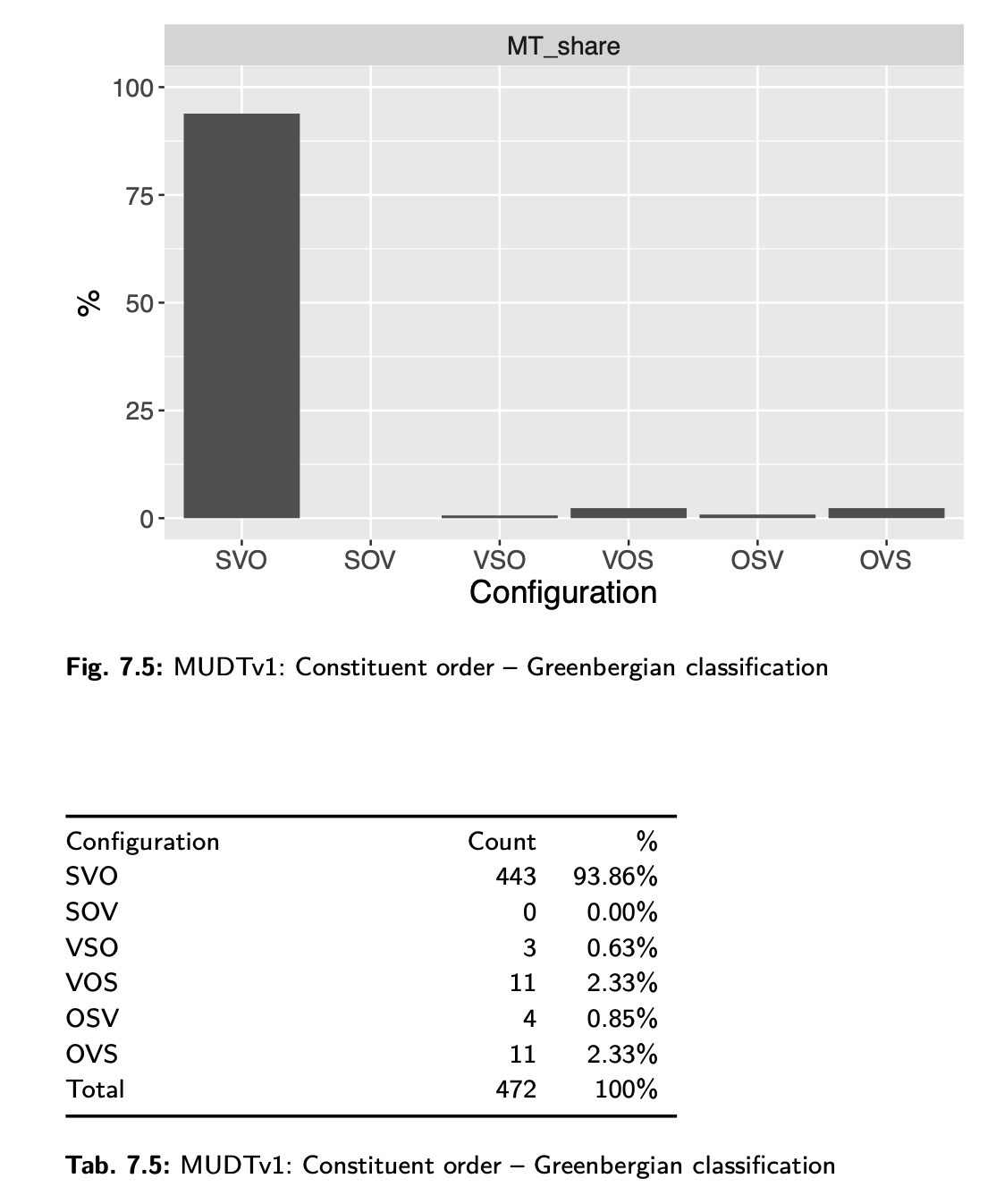
Now I am somewhat familiar with MUDT, seeing as I manually annotated the whole damn thing and then used it to get my PhD. In fact, a significant portion of my dissertation was dedicated to doing the exactly this kind of analysis - except I speak of "constituent order" - and my results were completely different. To compare, consider Fig. 7.5 and Tab. 7.5 from p. 190 (click to embiggen). 

Even if we focus just on the dominant order - or linearization, as Li & Liu (2025: 4) call it in line with common practice - the difference is striking: Li & Liu 2025 have 24% for SVO and 70% for VSO. In my analysis, VSO is nearly non-existent: only 3 sentences show that order (see p. 190); the vast majority of sentences (93.86%) exhibit SVO order.

So what giveth? It is of course, entirely possible that I was wrong, but surely I wasn't THAT wrong. Let's try to find out what happened and we might as well start with how Li & Liu got their numbers. And this is where we come across the first problem: they don't say. All we learn in the paper is that 

"All metric computations and statistical analyses, including correlation tests between variables, were implemented using the Python programming language (version 3.11)." 
(Li & Liu 2025: 3)

and 

"Our Python‑based tool extracts these linearizations directly from dependency structures, allowing the analysis to accommodate varied syntactic patterns and reflect actual language use." 

(Li & Liu 2025: 4)

and finally

"All metrics and values reportedin this study were computed independently using custom scripts developed by the authors."

(Li & Liu 2025: 12)

The code, however, is nowhere to be seen. Red flag number one.

OK, fine, ORANGE flag, because to be fair,  my data retention practices are not perfect either. The data I used is available online along with the text of the dissertation, but the instance of Annis I used to run queries on the treebank has gone to the eternal filesystem beyond. Then again, the queries I used are fully available online as Appendix C, so once I get Annis running again - or you do - all is good and my work can be fully reproduced

Except here's an issue: the treebank I used in my dissertation was UD version 1 and while it was current when I started annotating, by the time I finished, version 2.1 had come out.  Li & Liu (2025) write in 2025, by which time versions 2.15 and 2.16 were out. By that point, I had also updated MUDT to the current version, so we just need to find out which one they used... 

And here we have orange flag no. 2: they do not say. All we learn is that 

"The raw data used in this study are openly available from the UniversalDependencies (UD) treebanks at https://universaldependencies.org." 

(Li & Liu 2025: 12)

At the beginning of their paper, Li & Liu inform us that

"To ensure consistency and cross‑linguistic comparability, all treebanks in this study employed the Universal Dependencies (UD) annotation framework [15]. "

(Li & Liu 2025: 3)

Maybe the reference behind [15] will tell us. Well, no, it does not, since it leads to J.A. Hawkins's Efficiency and Complexity in Grammars. Reference [17] which is supposed to point to a work by Xanthos and Gillis points instead to De Marneffe et al. (2021) which is a paper on UD, so maybe stuff just got mixed up. De Marneffe et al. 2021, however,  is a general description of the framework, so alas, no info on the version here either. Also, nobody noticed this mix-up? Orange flag no. 3.

Let us therefore assume that Li & Liu (2025) used the most recent version available to them, 2.16. As of this writing, the current version is 2.17, but I am reliably informed by the portly gentleman who brushes my teeth that there were no relevant changes between the versions, so let's go with 2.17. And since we are dealing with a single treebank, we don't have to write any custom code or even deal with Annis; the fastest way to access any UD treebank in 2026 is to use grew-match. 

Y'all know how dependency grammars work: an utterance/sentence consists of tokens (≈ words) where each token is a dependent of another token, called the governor. There is one exception: in every utterance/sentence, there is a token - prototypically a verb - that does not depend on any other token; we call it the root. The relationship between the governer and a dependent is referred to as a dependency and it can be unlabeled or labeled. In UD, all dependencies are labeled according to a specific framework and as a shorthand, the dependencies are referred to by their label.

grew-match is a graph-based search engine for treebanks which allows the user to search for all kinds of things. It works with nodes (= tokens) and edges (= dependencies). It is powerful, but the query language can be a bit tricky, so let's look at an example:  

pattern { V -[nsubj]-> S;
          V -[obj]-> O }

Here we have three nodes, V, S, and O. They are connected to each other as follows: S depends on V and the dependency label is nsubj (= nominal subject), O depends on V through the dependency obj (= object). In other words, this looks for clauses where we have a Subject, Verb (or any other predicate) and Object. We could further specify what kind of part-of-speech V should be, but in UD, if it has an object, it is a verb, so let's keep it at that.

Now if you ran the query like I just did, grew-match would report "395 occurrences". This means that there are 395 sentences total where we have a transitive verb with both an overt subject and an overt object. This is consistent with the findings in my dissertation (p. 190, see above), with one caveat: MUDT annotation contains one more dependency that I treat as a direct object for purposes of constituent order analysis, namely obl:arg. This covers prepositional objects and it exists as a separate category for compatibility purposes (don't get me started). If we include it in our query like so

pattern { V -[nsubj]-> S;
          V -[obj|obl:arg]-> O }

we will get 473 results which matches the data above perfectly (modulo fixes between v1 and v2). 

The queries we have used so far do not take into account the order of the constituents and so for example, the third hit is an OVS sentence (sentence id 02_02J01:10). To consider the order, we adjust the query as follows:

pattern { V -[nsubj]-> S;
          V -[obj|obl:arg]-> O;
          V << S;
          S << O }

The double "less than" sign specifies the order of nodes; in this case, V should come before S and S should come before O. This query will thus retrieve all VSO sentences in the treebank. Recall that according to Li & Liu (2025: 8), this should be 70% of all sentences with V, S and O; according to my analysis, we should get 3.

And lo and behold, 3 sentences is what we get. Go ahead, try all the permutations, it will more or less be the same as in my dissertation.

So, I repeat, what giveth? Well, we have already seen three orange flags that point to a certain degree of sloppines on the authors' part, so let's... Hang on just a minute, what is the name of the journal this was published in? Entropy? What kind of a name is that for a ling...

"Entropy is an international and interdisciplinary peer-reviewed open access journal of entropy and information studies, published monthly online by MDPI." 

And now everything clicks into place and you will excuse me while I recover from the dizziness induced by the huge amount of red flags suddenly unfurled in front of my eyes.

For those of you not in the know, MDPI is a paper mill and predatory publisher. I will not dwell on the predatory part, just point out the following: every journal published by MDPI levies an article processing charge of 2600 CHF (2850 EUR).

The paper mill part is much more interesting. As of this writing, MDPI publishes 511 open access journals. This is on par with Oxford University Press, but much less than Springer, so that might not be suspicious. But let's take a closer look, for example at Entropy: it is the end of March 2026 and they have already published three issues of volume 27 containing 362 articles. That's four PEER REVIEWED articles a day, including holidays. One analysis of MDPI's production refers to "concerns about how peer review can be conducted effectively at this scale". That's putting it mildly.

To answer my question above, what giveth is that a) the authors of the paper are incompetent and b) there was no peer review to catch their incompetence. No one at MDPI cares as long as they pocket their 2600 CHF.

Incidentally, the aforementioned analysis focuses on the proliferation of "special issues" which allows the publisher to expand the number of articles published and thus their revenue. It turns out that Entropy published a special issue titled "Complexity Characteristics of Natural Languages". This special issue was edited by the same people who appear as "Academic Editors" (what the hell is even that) for the bullshit word order paper: Stanisław Drożdż, Jarosław Kwapień and Tomasz Stanisz. None of them is a linguist, they are all physicists and work at the Institute of Nuclear Physics of the Polish Academy of Science. They appear to be interested in what they call "quantitative linguistics" but what would better be described as "applying mathematical methods to texts". And don't get me wrong, this is a legitimate field of research, but maybe the gentlemen in question should devote more time to studying linguistics proper sparing us insights such as (emphasis mine)

"During their development languages have been gradually reshaping and adopting themselves under influence of other languages and dialects they have encountered. Especially English and Spanish experienced many of such encounters. Whether this made them as they are or they became global because they happen to possess some spontaneously acquired favorable intrinsic syntactic organization emerges an exciting issue for further interdisciplinary explorations."

or (emphasis mine)

"We found that although the global behaviour of words is described approximately by the Zipf-Mandelbrot law, the words from different parts of speech do not necessarily follow this global picture and one can show significant differences in functional dependence of frequency on rank between nouns, verbs and other types of words. This can be a manifestation of the existence of a non-trivial internal organization of language that cannot be reproduced in full detail by a simple power-law relation of the Zipf-Mandelbrot type."

Whether such a conclusion is worth the effort put into it, I will leave to the reader, accompanied by the appropriate XKCD comic (h/t a colleague who shall remain unnamed).
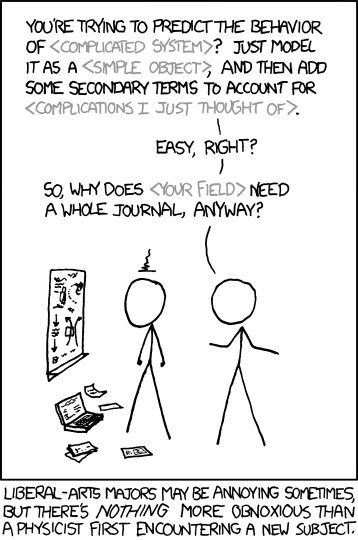
 Physicists

In any case, Messrs. Drożdż, Kwapień and Stanisz should be ashamed of their role in the predatory practices of MDPI in general and of this bullshit paper in particular.